
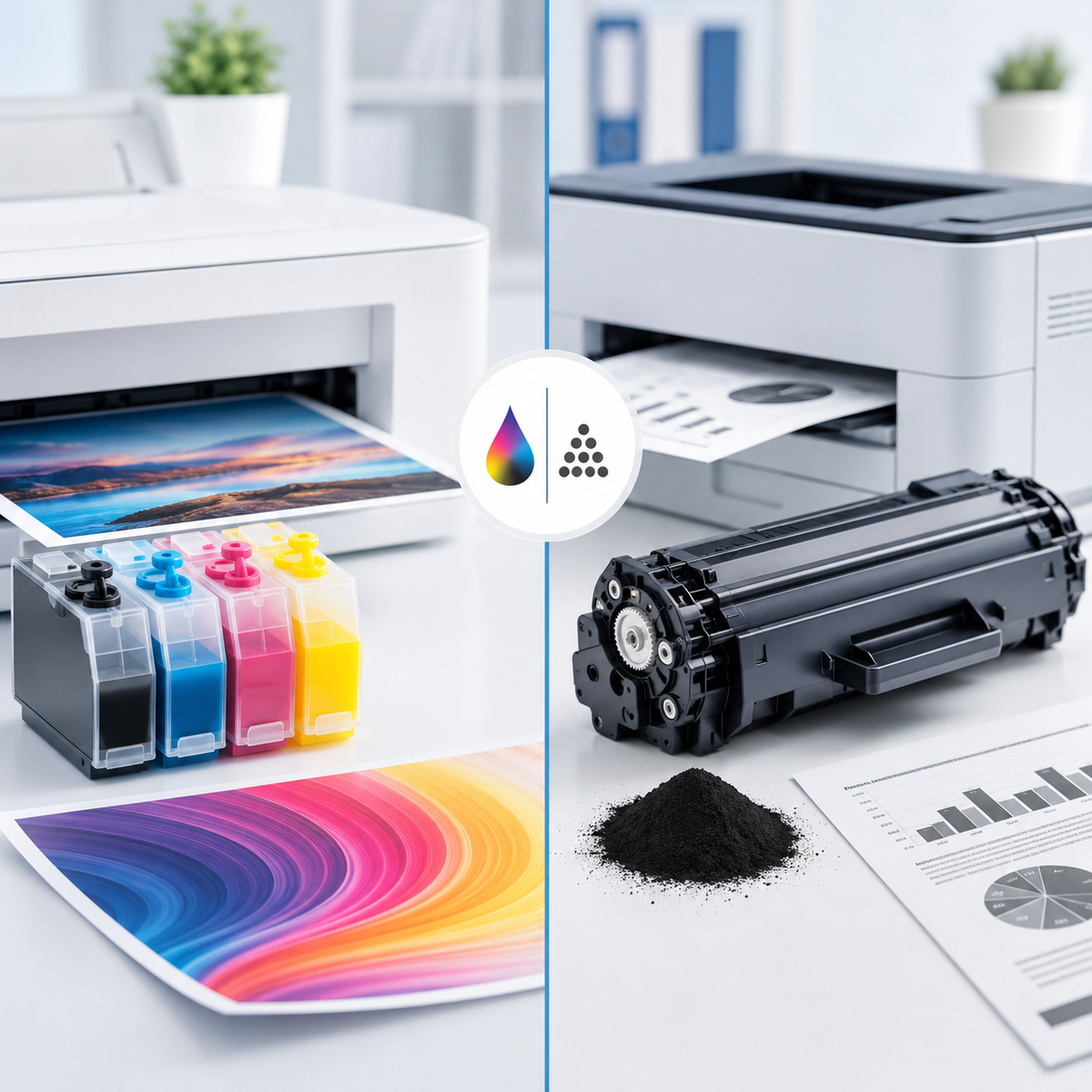
Ink and toner both create printed pages, but they are not interchangeable. Ink is a liquid used by inkjet printers. Toner is a fine powder used by laser printers. Choosing between them is really a choice between two different printing systems, each with its own strengths.
Ink vs. Toner at a Glance
Choose ink when you value versatile color output, photo printing, and a lower entry price for the printer. Choose toner when you regularly print larger volumes of text, value fast document output, or want supplies that are less affected by long periods of non-use.
What Is Printer Ink?
Printer ink is a liquid formulation stored in a cartridge or tank. During printing, a printhead releases tiny droplets onto the paper. Inkjet printers are widely used for home documents, school projects, presentations, graphics, and photos.
Ink may be dye-based, pigment-based, or a combination. Different formulas are designed for specific printheads and paper types, which is why cartridge compatibility should always be checked by printer model rather than appearance alone.
What Is Toner?
Toner is a dry powder used in laser printers. A laser or LED imaging system creates an electrostatic pattern on a drum. Toner particles are attracted to that pattern, transferred to the paper, and fused with heat and pressure.
Because toner is fused to the page instead of absorbed as a liquid, laser printing is especially effective for sharp text and high-volume business documents.
The Biggest Differences Between Ink and Toner
Printer Technology
Ink cartridges work only in compatible inkjet printers. Toner cartridges work only in compatible laser printers. A printer model is designed around one technology, so users cannot switch from ink to toner without changing printers.
Text and Photo Output
Inkjet printers are often the more flexible choice for mixed color work and photographs, particularly when used with coated photo paper. Laser printers are known for fast, crisp text and consistent business graphics. Color laser printers can produce strong charts and marketing materials, but they may not match a photo-focused inkjet for subtle photo gradations.
Print Volume and Speed
Laser printers are commonly chosen for frequent document printing because many models are designed for faster page output and larger paper workloads. Inkjet printers can still be a practical option for moderate use, especially when color quality and compact size matter more than maximum speed.
Supply Life During Storage
Liquid ink can dry around a printhead or nozzle when an inkjet printer is left unused for too long. Toner powder does not dry in the same way, which can make laser printers attractive for users who print irregularly. Toner still needs proper storage because moisture, heat, damaged seals, or rough handling can affect performance.
Upfront and Long-Term Cost
Inkjet printers often have a lower purchase price, although cost per page varies widely by model, cartridge size, page coverage, and maintenance behavior. Laser printers may cost more initially but can offer efficient document printing at higher volumes. The most useful comparison is total cost of ownership, not the price of one cartridge.
How to Compare Cost per Page
To estimate cost per page, divide the supply price by its stated page yield. For example, a $40 cartridge with an estimated yield of 1,000 pages has a simple supply cost of four cents per page. Real-world results may differ because page-yield estimates are produced under controlled test conditions, while actual documents use different amounts of ink or toner.
Also consider drum units, maintenance boxes, waste-toner containers, printhead cleaning, and paper. These items do not apply equally to every printer, but they can affect the true operating cost.
Which Is Better for Home Use?
Ink is often a good fit for households that print school assignments, occasional forms, craft projects, color graphics, and photos. Toner may be better for a household that mainly prints black-and-white documents, prints in larger batches, or leaves the printer unused for long intervals.
Which Is Better for a Small Office?
A small office that prints contracts, invoices, packing slips, reports, or training materials may benefit from a laser printer. A design studio, real estate team, classroom, or customer-facing business that needs varied color output may prefer an inkjet or a mixed printer setup.
Questions to Ask Before Choosing
· Do you print mostly text, photos, or a mix of both?
· How many pages do you print in a typical month?
· Do you need color on most pages?
· How important are print speed and paper capacity?
· Will the printer sit unused for weeks at a time?
· What are the prices and yields of the supplies for the exact model?
· Does the printer require separate drums or maintenance components?
Frequently Asked Questions
Is toner the same as black ink?
No. Black toner is a powder for laser printers. Black ink is a liquid for inkjet printers.
Can toner dry out?
Toner does not dry like liquid ink, but it can be damaged by poor storage, moisture, heat, contamination, or cartridge wear.
Is toner always cheaper than ink?
Not always. The answer depends on the printer, cartridge yield, document coverage, maintenance needs, and how frequently you print. Compare cost per page for the exact models under consideration.
Which is better for photos?
A photo-oriented inkjet printer is generally the stronger choice for detailed photographs and specialty photo media. A color laser printer is often better suited to fast business graphics and presentations.
Final Takeaway
Ink and toner solve different printing needs. Ink offers flexible color and photo capabilities, while toner supports fast, durable document workflows. Start with your monthly print volume and the type of pages you create, then compare the supply costs of specific printer models before making a decision.